

No bullshit, brutally honest: the biggest margin unlock in mobile gaming since the free-to-play transition and COVID UA is sitting right in front of you. It’s finally legal in the markets that matter, the window is wide open, and most of you still haven’t started.
This is the essay where I try to fix that. We covered a lot of this on the latest “3.5 Gamers” episode with Chip Thurston from FastSpring, so you’ll get his take alongside the data. Let’s dive in.
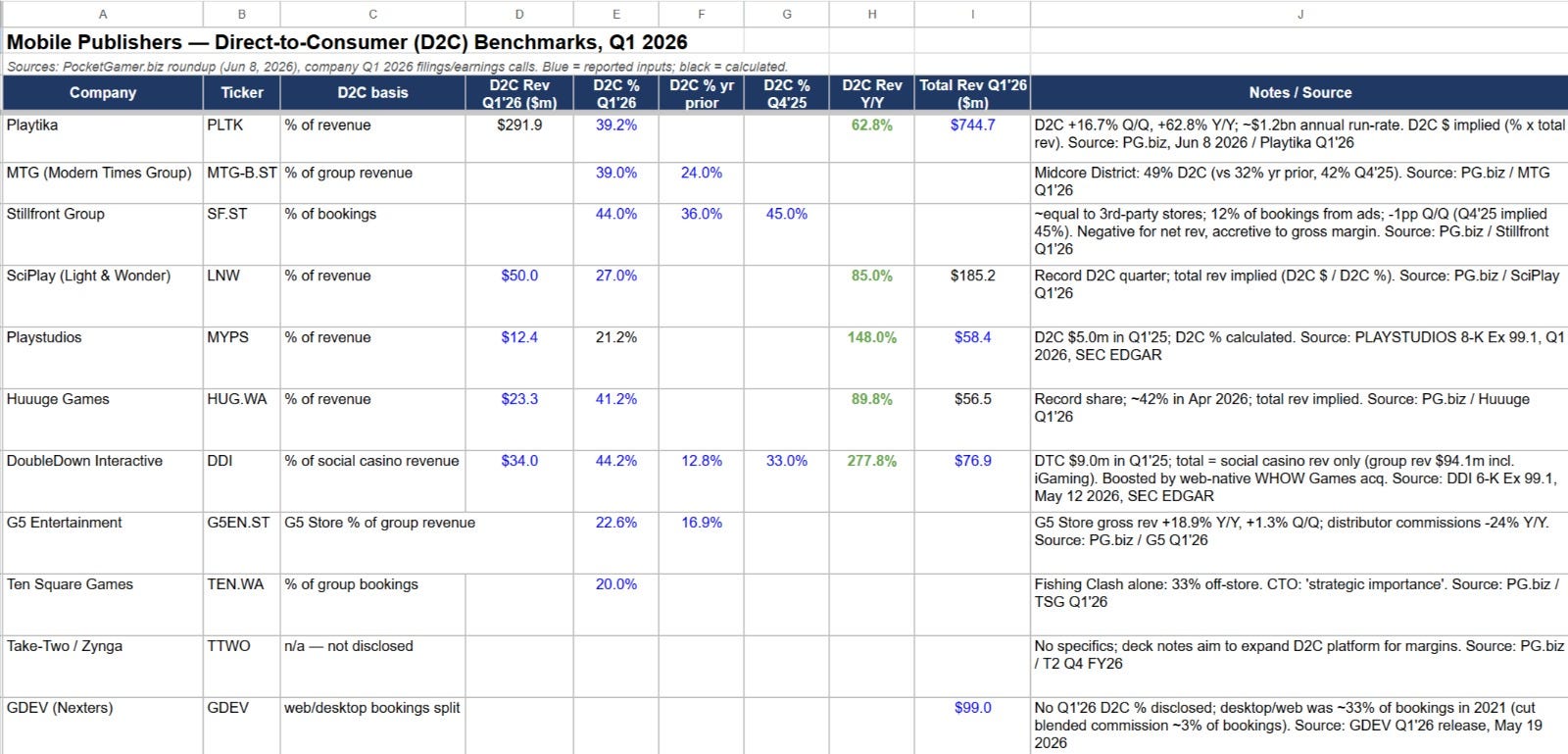
First, the proof, because I don’t do vibes
I’ve been tracking direct-to-consumer disclosures from every public mobile publisher, quarter by quarter, back to Q1 2024. Here’s what the data actually says.
For all of 2024, D2C was flat. Playtika, the most mature web shop operation in the industry, posted $171.5m, $173.7m, $174.4m, and $174.6m in DTC revenue across the four quarters of 2024. Four quarters, less than 2% total movement. As a share of revenue, it actually went backward: 26.3% in Q1 2024, peaking at 28.1% in Q3, then sliding to 26.9%, 25.4%, and bottoming at 25.3% in Q2 2025, their lowest share in over a year. MTG sat at exactly 19% of group revenue for three straight quarters. Stillfront bounced between 33% and 34% of bookings all year. Huuuge was at roughly 12% in Q3 2024. The conference panels said “D2C is the future,” and the numbers said, “not yet.”
Then the wall came down. US courts killed Apple’s anti-steering rules in April 2025, and Apple has been losing appeals ever since, all the way up to a Supreme Court that refused to even hear the case.
Japan’s Mobile Software Competition Act went live in December 2025. The moment publishers could legally tell players the web shop exists, every chart bent upward in the same two quarters:
Playtika: $175.9m in Q2 2025, then $209.3m (+19% Q/Q), then $250.1m (+19.5% Q/Q), then roughly $292m in Q1 2026 (+16.7% Q/Q, +62.8% Y/Y). From 25.3% of revenue to 39.2% in four quarters, now a $1.2bn annual run-rate. Meanwhile their third-party platform revenue declined every single quarter of 2025, down 9.9% Y/Y to $428.7m in Q4.
MTG: 19%, 19%, 19% through 2024, then 24%, 24%, 26%, 32%, 39%. The share doubled in five quarters. Their Midcore District went from 32% to 49%, so half of that business is now off-store.
Huuuge: ~12% in Q3 2024 (15% by October), 20% in Q1 2025, 37% in Q4 2025, 41.2% in Q1 2026 and roughly 42% in April. In dollars: about $12.3m in Q1 2025 to $23.28m in Q1 2026, up 89.8% Y/Y.
Stillfront: 34% of bookings in Q4 2024, then 36%, 39%, 44%, 45%, settling at 44% in Q1 2026. D2C now matches the app stores, with another 12% from ads. Apple and Google are minority partners now.
SciPlay: 13% of sales in Q4 2024, ~18% ($35m) in Q2 2025, 25% ($48m) in Q4, 27% ($50m) in Q1 2026. Dollars up 85% Y/Y.
DoubleDown: 12.8% of social casino revenue ($9.0m) in Q1 2025, 33% in Q4, 44.2% ($34.0m) in Q1 2026. Nearly 4x the dollars in twelve months.
G5 Entertainment: G5 Store at 13.2% of revenue in Q4 2023, 19% in Q4 2024, 22.6% in Q1 2026, with store gross revenue growing 38.5%, 30%, 20.1% and 18.9% Y/Y across the last four quarters. Distributor commissions down 24% Y/Y.
Playstudios: D2C from $5.0m in Q1 2025 to $12.4m in Q1 2026, up roughly 150%.
Nine companies. One inflection point.
Chip’s framing on the pod was useful: think of it as three cohorts. Social casino (SciPlay, Playstudios, Huuuge, DoubleDown) runs 27 to 44% of revenue through D2C, because it is so VIP-concentrated that shifting a small percentage of players moves a huge share of revenue. Midcore (MTG, Stillfront, Ten Square) runs up to 44%+ on community-heavy games. And before you say, “Fine, but my genre is different,” there’s the casual cohort.
The “D2C doesn’t work in casual” excuse is dead
This was the most common pushback for years, and the report quietly killed it. Playtika now generates 76% of its total revenue from casual, not social casino. They broke it out in the earnings report themselves: Slotomania is sunsetting, casual is the business. So when Playtika reports 39.2% of total revenue via D2C, that is mostly casual money. Disney Solitaire money. As Chip put it on the pod, any casual developer still skeptical of D2C should go look at Playtika.
And the geography excuse is equally dead. SciPlay and Playstudios are US/Israeli, Huuuge is European, and DoubleDown is Korean. It doesn’t matter where you’re headquartered. It matters where your players are. And if you have US players, which is literally everybody, the window is open for you right now.
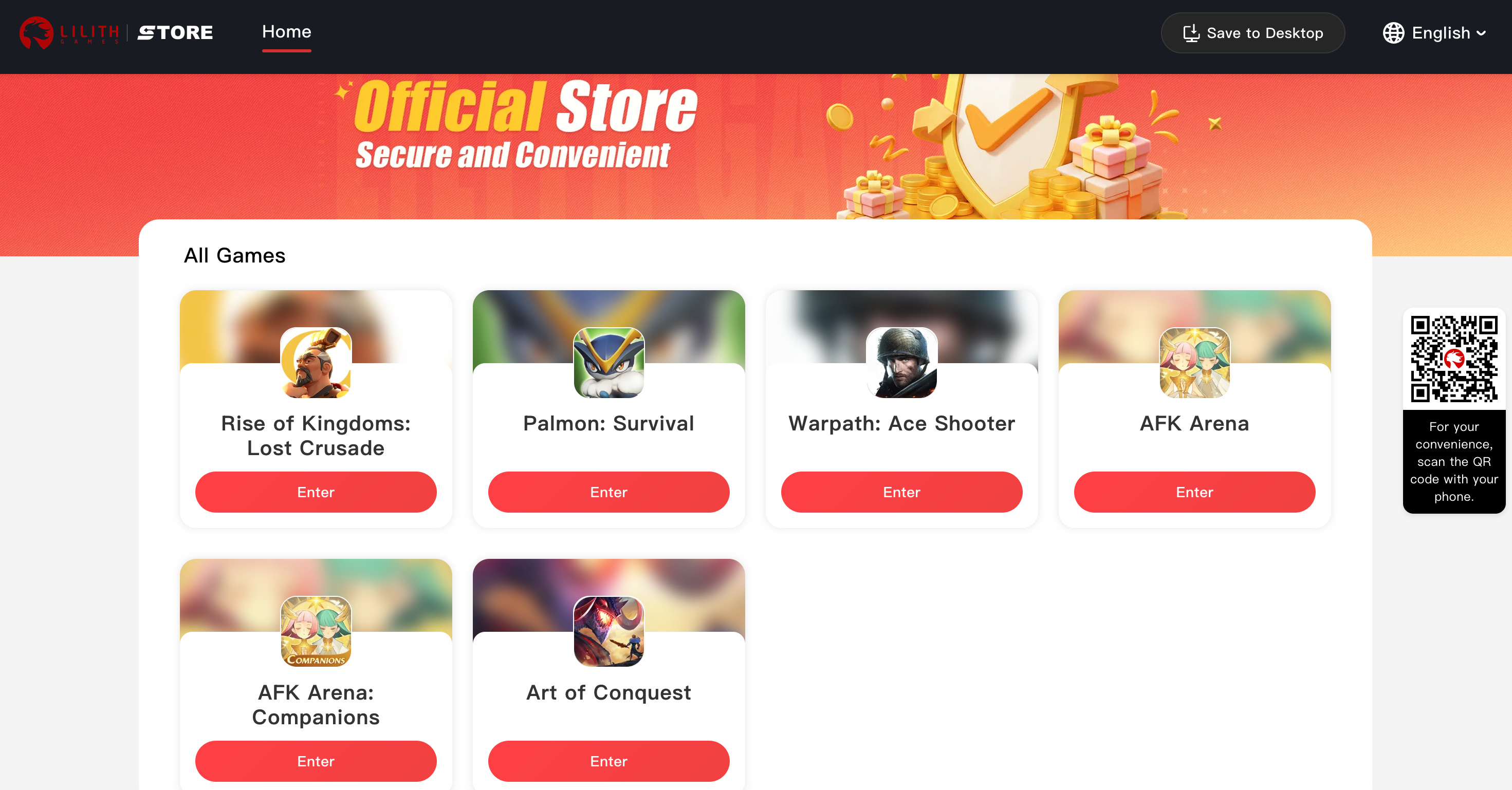
One more thing before the playbook: this public data is the tip of the iceberg. Scopely, Dream Games, and every other private or PE-owned studio run D2C without reporting a cent. China has been doing this for a decade: Lilith and 37 Entertainment have run their own stores for years, invisible to Western dashboards.
Why the urgency: the window has an expiry date
Here’s what most people sharing the hockey-stick charts on LinkedIn don’t understand. The current state, where you can steer US players to web payments without paying any platform fee, is temporary.
The Epic-Google settlement, still awaiting court approval, sets a 20% fee on linked payments with a 24-hour attribution window. Google intends it to take effect on June 30, 2026, in the US and Europe. Whether the judge signs by then is, in Chip’s words, a coin flip. On the Apple side, Cupertino has exhausted nearly every appeal and is now negotiating linked-payment fees with Epic on a timeline running through October 2026. Chip’s read, and mine: Apple fast-follows whatever the Google settlement establishes, with new fees landing late 2026 or early 2027.
Meanwhile, Google is already laying the plumbing. The External Content Links program went into effect January 28, 2026, in the US: if you link out of your app, you must be enrolled, or your updates get disapproved. First enforcement cases showed up in May. No fees yet, because legally there can’t be, but the fee schedule is already written into the guidelines: 20% on linked payments, and the old 30% decoupled into 5% billing plus a 20-25% platform fee depending on install date.
So the math is simple. Today: 0% platform fee on steered US payments. Sometime in the next 6 to 12 months: probably 20%. Still better than 30%, but a third of the prize evaporates for traffic you haven’t habituated by then. On the pod, I compared it to COVID UA: there were two schools then, too. One said, “This is temporary, stay cautious,” the other spent everything they had on the cheapest installs in history. Guess who won. This is the same kind of window. Limited time, closing soon, and the players you move now stay moved.
The playbook: how to actually start
This is the definitive guide part. Eight steps. No fluff.
Step 1: Start with your VIPs, not your DAU. Your top 2-5% of payers drive the majority of revenue, they’re emotionally invested, and they’ll happily take a better deal directly from you. Social casino proves the leverage: shift a small slice of players, shift a third of revenue. Ten Square’s data shows the same pattern at game level: Fishing Clash, their most community-driven title, runs at 33% off-store while the group average is 20%. It’s the first time a publisher has named a per-game D2C number, and the lesson is: engaged communities convert.
Step 2: Don’t build payments from scratch. Unless you’re Playtika-sized, use the stack that exists: FastSpring, or other providers. Web shop fees run around 5% per transaction with hundreds of local payment methods built in. Appcharge went from zero to a $200m run rate in two years; that’s how much demand there is. Your engineers should be improving the game, not rebuilding Stripe with extra steps. Integration is weeks, not quarters.
Step 3: Run the hybrid: direct checkout links now, web store habituation forever. This is the most tactical thing Chip said the entire episode. Direct checkout links emerged through 2025: instead of sending the player to a store, the buy button takes them straight to a hosted checkout page, saved payment info, one tap, boom, back into the game. It’s the most frictionless path that exists, and with it, 50%+ of revenue through D2C is achievable today. Chip has heard 70% floated as this year's target. But every direct checkout link is by definition a linked payment, which means it’s exactly what the future 20% fee will hit. So the strategy is a mix: use direct checkout to maximize revenue during the free window, while building web store awareness and habit, because a destination players know and return to on their own is the asset that survives any settlement. If you rely on direct checkout alone, the fee lands and you start from zero.

Step 4: Make the shop feel like the game, then build a flywheel. Same art, same currency, same vibe. The player should feel like they walked into another room of the same house, not a sketchy parking lot. Then steal the best mechanic on the list: Raid: Shadow Legends gives points on every web store purchase, redeemable only there. Every purchase increases the likelihood of the next purchase. That’s a retention loop for your cash register.
Step 5: Build the steering machine. The shop is the easy part. Traffic is the moat. CRM, email, Discord, social, push, and in-game messaging where the law now allows it. This is why D2C rewards live-ops discipline: the same muscles that run your events calendar run your web shop promotions. If you’ve been ignoring CRM because “we’re a mobile game,” congratulations, you now have a business reason to grow up.
Step 6: Enroll in External Content Links today. Even though fees aren’t live. The integration isn’t trivial, there’s an API and hoops to jump through, and the publishers getting app updates rejected right now are the ones who ignored it. Do the prep while it’s optional so that when policy flips, you change your monetization strategy, not your codebase. Being caught flat-footed here is a choice.
Step 7: Use Japan as your soft launch for the fee era. Japan’s Mobile Software Competition Act, live since December 2025, allows steering on both platforms with fees. That makes it the first real laboratory for the post-settlement world. Run your steering playbook there now, learn when it’s worth incurring a fee versus avoiding it, and you’ll have the fee-era operating manual written before the US and EU even get there. Japanese players are extremely high spenders anyway; Monster Strike still does around a billion in its home market alone. Low-risk learning, high-value market.
Step 8: Incentivize with discipline and measure net. Stillfront said the quiet part out loud in their own filing: aggressive incentives are “negative for net revenue but accretive to gross profit.” You’re paying players bonus currency to skip the store, and if you go stupid with the bonuses, you’re just moving the 30% from Apple’s pocket to your players’ pockets. Their D2C share even slipped a point in Q1 2026 on product mix; this share is managed, not magic. And remember the dashboards are blind: Sensor Tower doesn’t see web spend, which is how Playtika “declined” on third-party platforms every quarter of 2025 while growing 5.5% Y/Y to $744.7m. Track your own blended numbers and stop benchmarking icebergs by their tips.
The two traps that kill it
Trap one: D2C doesn’t resurrect a dead game. Ten Square Games has run a web store for years, and the share is stuck: above 19% in March 2025, 20.3% in September, 18.7% in December, 20% in Q1 2026. Flat for a year, because Fishing Clash and Hunting Clash bookings are falling, and D2C falls with them. A web shop is a better cash register, not a better store. If your D7 retention is in the gutter, fix the game first. You can only scale your budget and your web shop as far as the LTV allows. Full stop.
There’s a more interesting version of the same lesson, and it comes from the company that was doing D2C before it was cool: Nexters. GDEV has been running Hero Wars across PC, web, and mobile for years, launched their mobile web shop back in mid-2023, and their off-store share of bookings has lived in the 37 to 43% range ever since, with platform commissions to match. They earned their hockey stick years before everyone else. But in Q1 2026, while the rest of the industry was bending upward, their off-store share actually slipped from 41% to 36%. Not because the strategy failed: Hero Wars is a decade-old game with a mature, concentrated spender base (roughly 125,000 high payers drive 88% of bookings), and as that base shifts, the channel mix shifts with it. The takeaway isn’t that Nexters did something wrong. It’s that D2C share is not a ratchet that only goes up. It’s a live metric that tracks the health and habits of your paying audience, quarter by quarter. The pioneers prove the ceiling is real; they also prove you have to keep earning it.
Trap two: copying instead of learning. Chip’s warning, and it applies to everything in this guide: don’t look at Disney Solitaire’s web store and clone it. Your players have their own tolerance for friction, their own purchase moments, their own incentive sensitivity. The nine companies above are a library of best practices, not a template. D2C is a live-ops surface. Iterate it like one.
And one meta-trap: don’t let UA quietly eat the whole prize. UA spend has exceeded app store fees industry-wide since 2020, and the early D2C winners are pouring savings straight back into Meta and AppLovin auctions. Take-Two posts record mobile D2C and guides opex up in the same breath. Reinvesting is the point, but decide deliberately how much goes to growth and how much to margin, or the auction decides for you. Because the competitive math is brutal: Playtika at 39.2%, Huuuge at 41.2%, and DoubleDown at 44.2% have structurally higher net LTV than you on the same user, which means a higher CPI ceiling, which means they outbid you in every auction you both enter.
Start this quarter
Here’s the thing about hockey sticks: the inflection already happened. You’re not early anymore. But you’re also not late. Huuuge went from 12% to 41% in six quarters. DoubleDown went from 12.8% to 44.2% in four. The distance between “we have nothing” and “D2C is our biggest channel” is about eighteen months of consistent execution. Not a genius. Consistency.
But the free-steering window is measured in months, not years.
So: pick a vendor this month. Ship a VIP-only store next quarter. Turn on direct checkout links while they’re fee-free. Enroll in External Content Links before you’re forced to. Run the Japan experiment. Wire your CRM into all of it and iterate like it’s a live-ops event, because it is one.
The publishers on those charts aren’t smarter than you. They just started. So, like I said at the end of the episode: go and start your fucking web store. Right now.
BENCHMARKS sheet with real data from 2024 until today
I put together the real data from all the companies and their financial reports into a sheet, mapping 2024 until today!